
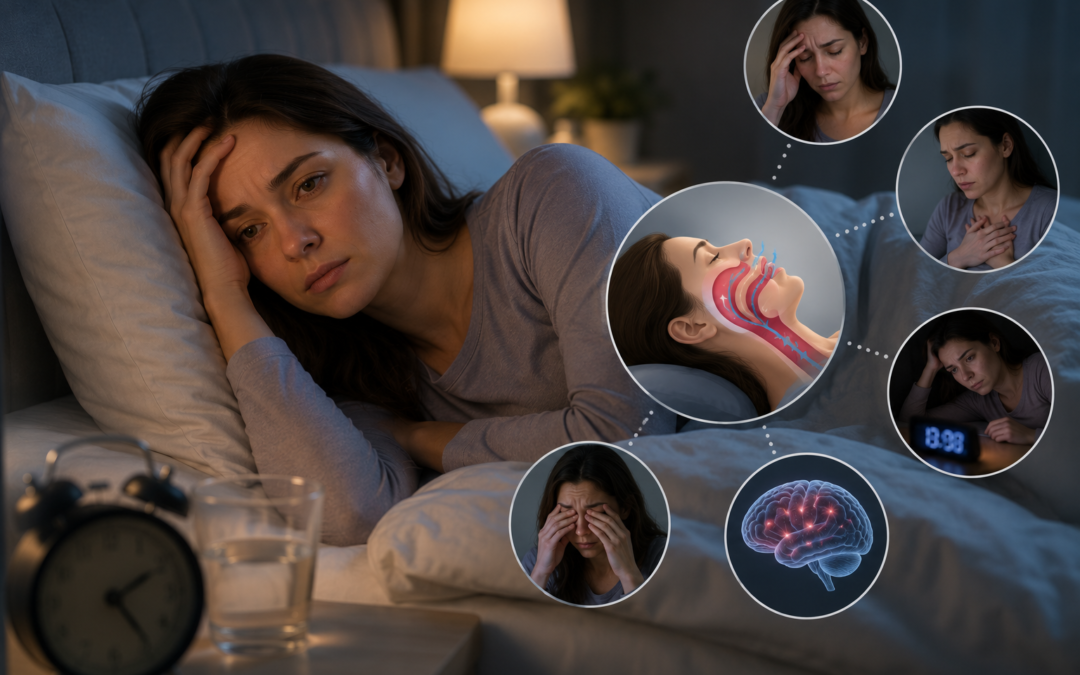
Sleep apnea does not look the same in women. Men come in with loud snoring and a partner who has already noticed the breathing pauses. Women come in exhausted, told for months that it is stress, or hormones, or anxiety. The symptoms are real. The diagnosis is just wrong. Because the textbook picture was built around men, many women with obstructive sleep apnea go years without anyone ordering a sleep study.
According to Dr. Sharada Panse, who provides Sleep Disorder Treatment in Mumbai at Nidra Health Clinic, this gap between onset and diagnosis is one of the most common patterns she sees in female patients.“By the time most women reach me, they have already been treated for depression or thyroid issues or chronic fatigue. Nobody considered that the sleep itself might be the problem.”
How does sleep apnea actually show up in women?
Sleep disorders don’t all behave the same way, and they definitely not all respond to the same treatment. Dr. Panse works as a sleep disorder specialist across the whole spectrum, from the conditions she sees most weeks to the ones a lot of clinics rarely come across. Her sleep disorder treatment in Mumbai almost always begins with a proper diagnosis rather than a quick prescription.
Tiredness, not sleepiness
Women rarely fall asleep at traffic signals the way the textbooks describe. They just feel ground down by afternoon, every single day.
Broken sleep labelled as insomnia
Waking at 2am and lying there for an hour is not automatically insomnia. In women with sleep apnea, the airway is disrupting sleep and the insomnia is a consequence, not the cause.
Headaches and low mood
These two show up together frequently. Morning headaches that lift by midday, combined with irritability or flat mood, point toward overnight oxygen drops more often than most clinicians check for.
Menopause raises the risk sharply
Progesterone has a protective effect on airway muscle tone. When it drops after menopause, the risk of obstructive sleep apnea in women rises to roughly three times that of premenopausal women the same age. New symptoms around that window need proper investigation, not just hormone management.
Fatigue and broken sleep that have not responded to other treatments are worth a sleep assessment.
Why do standard tests still miss it?
Built for the wrong patient
Screening tools like STOP-BANG score neck size, loud snoring, and witnessed breathing pauses. Women report fewer of those even when their sleep study shows significant apnea. Only about a third of women with confirmed OSA score high enough to trigger a referral.
Sent to the wrong specialist
Women who come in with fatigue or low mood get referred to psychiatry or endocrinology. The sleep angle gets considered last, sometimes years later.
Atypical symptoms need to be taken seriously
Repeated waking, unrefreshing sleep, and morning headaches that do not respond to standard treatment are all valid reasons to order a sleep study. They are not automatically insomnia or stress.
The test is simpler than most people expect
A home sleep study is done in the patient’s own bed. Results come back within days and give a clear, objective answer about what is happening overnight.
Women who have spent years cycling through diagnoses that never quite fit often find the sleep study is the one test that was never done. Read more about Dr. Panse’s approach to diagnosis.
Why choose Dr. Sharada Panse
Dr. Sharada Panse holds an MD in Respiratory Medicine and completed a full Fellowship in Sleep Medicine at St. John’s Medical College, Bangalore, one of the few institutions in India running three dedicated sleep laboratories. Before that she worked at P.D. Hinduja Hospital in Mumbai and completed a clinical observership at NIMHANS, Bengaluru, which gave her a neurological lens on sleep disorders that most pulmonologists do not have. She is an active member of the World Sleep Society and the Indian Sleep Disorders Association.
She now consults full time at Shushrusha Citizens’ Co-operative Hospital, Dadar. The cases she sees range from straightforward OSA to narcolepsy, REM behaviour disorder, and circadian rhythm conditions that many clinics rarely encounter. Her approach does not change across those: find the actual cause first, then treat that rather than just the presenting symptom.
FAQs
Can a woman have sleep apnea without snoring?
Yes. Loud snoring is less common in women with OSA. Its absence does not rule out the condition.
How is it diagnosed?
A sleep study, either at home or in a lab, records breathing and oxygen levels through the night. It gives a definitive answer.
Does menopause make it worse?
It raises the risk significantly. Postmenopausal women are about three times more likely to have moderate or severe OSA than premenopausal women.
What is the treatment?
CPAP works well for moderate to severe cases. For milder apnea, a mandibular advancement device is a practical alternative.
References
- Bouloukaki I, Tsiligianni I, Schiza S. Evaluation of Obstructive Sleep Apnea in Female Patients in Primary Care. Medical Principles and Practice. 2021.https://pmc.ncbi.nlm.nih.gov/articles/PMC8740168/
- Krishnan V, Collop NA. Gender differences in sleep disorders. Current Opinion in Pulmonary Medicine. 2006.https://pmc.ncbi.nlm.nih.gov/articles/PMC5323064/
