
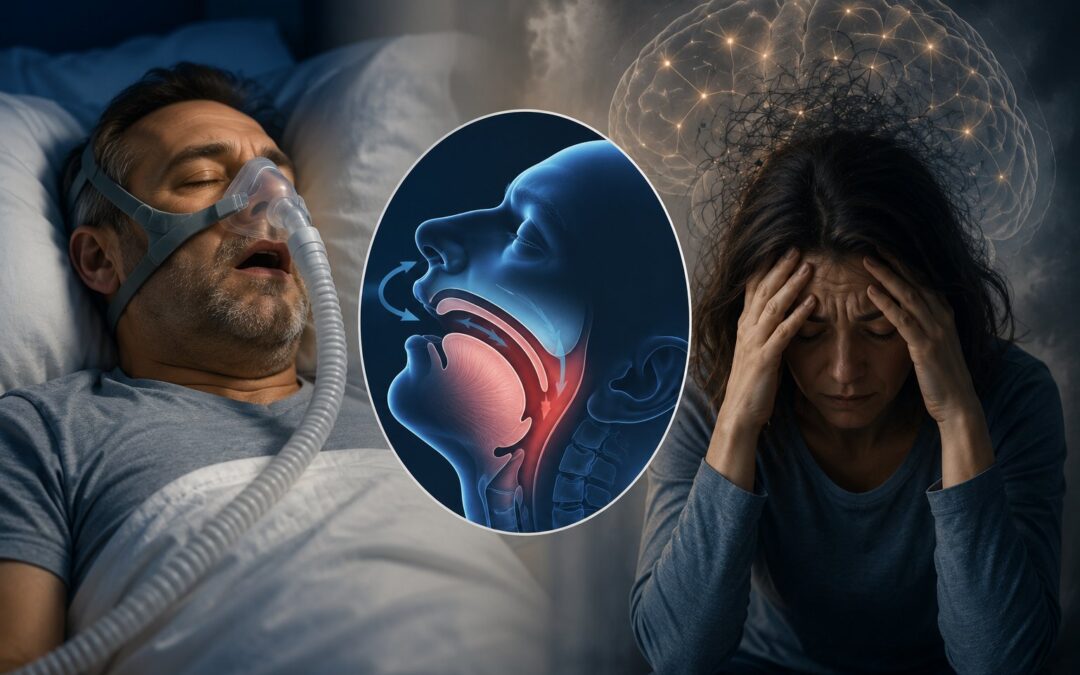
Up to 35% of people with obstructive sleep apnea have depressive or anxious symptoms. That number is high. But what makes it clinically important is not the statistic — it is that the relationship runs both ways. OSA can trigger depression and anxiety. And depression can worsen OSA. Each feeds the other. Which means treating only the mood disorder, without ever checking the sleep, is one of the main reasons patients stay stuck for years.
According to Dr. Sharada Panse, who provides Sleep Disorder Treatment in Mumbai at Nidra Health Clinic, undiagnosed OSA is one of the most common reasons depression does not respond to treatment.“Undiagnosed OSA sitting underneath depression will blunt every treatment aimed at the mood. A sleep study should come before escalating psychiatric medication.”
How does sleep apnea affect mood and mental health?
Oxygen drops hit the brain directly: Every apnea event drops blood oxygen. The brain fires a stress response. Do that dozens of times a night and the neurological fallout starts to look like anxiety, because in many ways it is.
Sleep fragmentation breaks emotional regulation: Deep and REM sleep are where the brain processes emotional memory. Apnea keeps pulling people out of those stages repeatedly. Over time, irritability increases, mood flattens, and emotional regulation gets harder. Not because of life circumstances. Because the brain is not getting what it needs overnight.
Fatigue, low motivation, difficulty concentrating, withdrawing from things you used to enjoy. These are depression symptoms. They are also exactly what untreated moderate-to-severe sleep apnea looks like, every single day, in people who have no idea their airway is the problem.
The anxiety link is physical: Repeated nocturnal arousals push the sympathetic nervous system into a state of sustained activation. That low-level physiological alertness carries into the day. Clinically it presents as anxiety. The brain is not catastrophising. It is responding to what is genuinely happening overnight.
Patients who have been on antidepressants for months without real improvement are worth evaluating for a sleep disorder.
What happens when the sleep apnea is actually treated?
Mood improves. Not in every case, but consistently enough across studies that it changes how you approach a patient whose depression is not responding. CPAP has been shown to reduce depressive symptom scores in multiple trials. That is not a side benefit. That is the apnea being the actual problem.
Anxiety settles too. When apnea events are controlled and REM sleep is restored, the overnight sympathetic overdrive gradually reduces. Patients frequently report feeling less on edge within weeks, before any change in psychiatric medication has been made.
But here is what most people do not get told. Antidepressants and anxiolytics work better when the brain is getting adequate, consolidated sleep. Treating the mood disorder while leaving untreated OSA in place is like bailing a boat without checking for the hole. The treatment is real. The problem is that something else is undermining it.
The practical step is straightforward. A sleep study before escalating psychiatric treatment is reasonable in anyone whose mood disorder is not responding as expected. One night. Objective result. Clear answer.
People who have spent years cycling through mood treatments that never quite held often find that fixing sleep is what finally changes things. Learn more about how Dr. Panse approaches the sleep and mental health overlap.
Could better sleep be the key to improving your mental health—ready to find out?
Why Choose Dr. Sharada Panse?
Dr. Sharada Panse holds an MD in Respiratory Medicine and completed a Fellowship in Sleep Medicine at St. John’s Medical College, Bangalore, one of very few institutions in India with three working sleep laboratories. She trained at P.D. Hinduja Hospital, Mumbai, and completed a clinical observership at NIMHANS, Bengaluru, where the psychiatric and neurological dimensions of sleep disorders are central to the clinical work. She is a member of the World Sleep Society and the Indian Sleep Disorders Association and consults at Shushrusha Citizens’ Co-operative Hospital, Dadar.
FAQs
Can treating sleep apnea improve depression?
It can, and often does. CPAP therapy has shown consistent reductions in depressive symptom scores across multiple studies. Anyone whose depression has not responded to standard treatment should have OSA ruled out first.
How do I know if my anxiety is linked to sleep apnea?
Anxiety that is worse in the mornings, combined with waking unrefreshed and a constant physical restlessness that does not match your actual circumstances, points toward overnight sympathetic activation from apnea rather than a primary anxiety disorder. A sleep study gives the answer.
Can sleep apnea cause panic attacks?
Nocturnal panic attacks specifically have been linked to apnea events. If panic attacks happen at night or on waking, OSA is worth investigating.
Does depression cause sleep apnea or is it the other way around?
Both. Depression affects upper airway muscle tone and worsens breathing during sleep. OSA drives the hormonal and neurological changes that produce depression. Either one can come first.
References
- Pan ML, Tsao HM, Hsu CC, et al. Bidirectional association between obstructive sleep apnea and depression: a population-based longitudinal study. Medicine. 2016. https://pmc.ncbi.nlm.nih.gov/articles/PMC5402579/
- Garbarino S, Bardwell WA, Guglielmi O, et al. Association of anxiety and depression in obstructive sleep apnea patients: a systematic review and meta-analysis. Behavioural Sleep Medicine. 2020. https://pmc.ncbi.nlm.nih.gov/articles/PMC11773896/
