
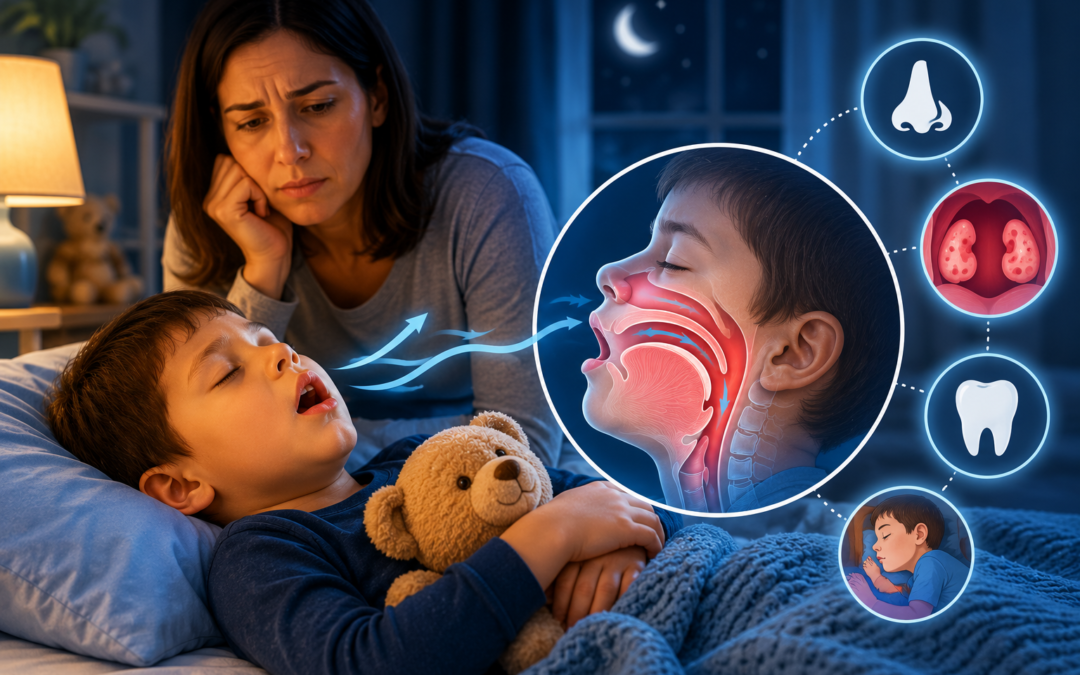
A child snoring through a cold is nothing to worry about. But if it is loud, happens most nights, and you are hearing gasping or long pauses in the breathing that is a different situation. Snoring three or more nights a week, combined with restless sleep and behavioural changes during the day, points toward sleep-disordered breathing. Sometimes obstructive sleep apnea. The snoring is just the sound. The actual problem is what the airway is doing while your child sleeps.
According to Dr. Sharada Panse, who provides Sleep Disorder Treatment in Mumbai at Nidra Health Clinic, paediatric sleep apnea is missed far more often than it should be because the daytime signs get blamed on behaviour instead of sleep.“Children with untreated sleep apnea do not always look tired. They look difficult. Hyperactive, distracted, struggling at school. By the time they reach me, some have already been assessed for ADHD.”
What signs should parents watch for?
Breathing pauses are the clearest signal: Not just snoring actual stops in breathing followed by a gasp or a stir. If you have seen that, it needs to be assessed. That is an apnea event.
The snoring itself matters too: Loud enough to hear from another room, happening most nights, with snorting or choking sounds. Not the soft snoring of a stuffy nose. Something heavier.
Watch how they sleep: Kids with airway obstruction move constantly. Hyperextending the neck, ending up sideways or sitting up, changing position over and over. The body is trying to find a way to breathe better.
The daytime signs are what get missed: Hyperactivity. Short fuse. Bedwetting. Trouble waking up. Struggling at school. These are the things parents bring to a paediatrician and they are also documented consequences of untreated paediatric OSA.The sleep connection Children who snore regularly and show any of these signs deserve a proper sleep assessment not months of watching and waiting.
What causes it and what can actually be done?
Tonsils and adenoids first:Large tonsils and adenoids relative to the airway size. Adenotonsillectomy fixes OSA in the majority of otherwise healthy children.Not all of them but most.
Obesity makes it harder: The picture has changed over the past twenty years. More than half the children now referred for snoring at major sleep centres are obese. That adds a mechanical and inflammatory component that surgery alone does not always resolve.
The sleep study is what actually tells you what is happening. Clinical assessment parental reports, examination, tonsil size has good sensitivity but poor specificity. A child can look concerned and have a normal study. Or look fine and have significant apnea. One night of objective measurement removes the guesswork completely.
Treatment follows the result. Adenotonsillectomy, positional management, weight management, CPAP in some cases. What matters is that the choice is based on what the study shows, not on clinical impression alone. Paediatric OSA left untreated has real consequences for the brain, for behaviour, for the cardiovascular system. The good news is those consequences are largely reversible when it is caught and treated early.
Learn more about Dr. Panse’s approach to sleep-disordered breathing in children.
Is your child’s snoring affecting their sleep, behavior, or daily activities—have you considered a consultation with Dr Sharada Panse?
Why Choose Dr. Sharada Panse?
Dr. Sharada Panse holds an MD in Respiratory Medicine and completed a Fellowship in Sleep Medicine at St. John’s Medical College, Bangalore one of very few centres in India running three dedicated sleep laboratories. She has trained at P.D. Hinduja Hospital in Mumbai and completed a clinical observership at NIMHANS, Bengaluru. Member of the World Sleep Society and Indian Sleep Disorders Association. Consults at Shushrusha Citizens’ Co-operative Hospital, Dadar.
Children’s sleep disorders present differently from adults. She looks at the full picture of sleep history, daytime behaviour, clinical findings before recommending anything.
FAQs
At what age can children develop sleep apnea?
Any age. Including toddlers. The peak is between two and eight years when tonsil and adenoid size is largest relative to the airway.
Is snoring in children ever just normal?
During a cold, yes. Habitual snoring three or more nights a week with no illness is not normal and needs to be checked.
Will my child need surgery?
Not automatically. Adenotonsillectomy is the most common treatment and works well in most healthy children. But it depends on what the sleep study shows and the individual clinical picture.
Can untreated sleep apnea affect development?
Yes. Hyperactivity, poor concentration, reduced academic performance, neurocognitive deficits all consistently linked to paediatric OSA in research. Most of it reverses with treatment, which is why catching it early matters.
References
- Kaditis AG, Alvarez MLA, Boudewyns A, et al. Obstructive sleep disordered breathing in 2 to 18-year-old children. European Respiratory Journal. 2016. https://pmc.ncbi.nlm.nih.gov/articles/PMC2645257/
- Gozal D, Kheirandish-Gozal L. Pediatric obstructive sleep apnea: complications, management, and long-term outcomes. Respiratory Care Clinics. 2010. https://pmc.ncbi.nlm.nih.gov/articles/PMC2645258/
