
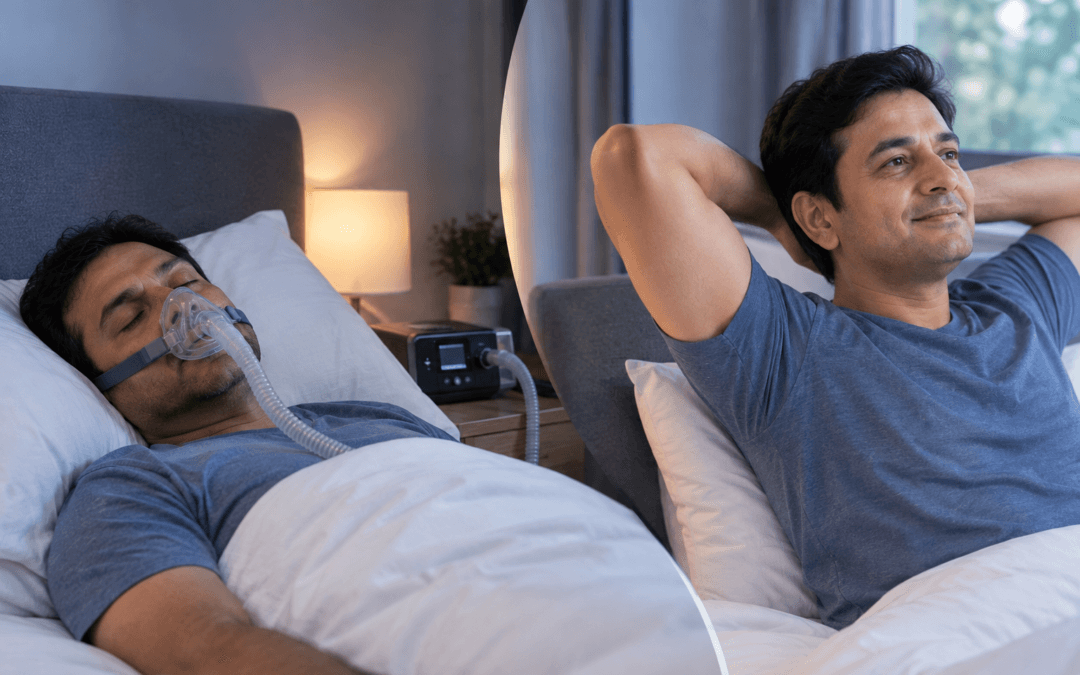
Timelines vary by condition, but most patients notice change somewhere between two weeks and three months. CPAP tends to bring relief fastest. CBT-I for insomnia takes longer to build but tends to last. Either way, sleep treatment isn’t instant, and expecting overnight results usually leads to disappointment.
According to Dr. Sharada Panse, an expert in sleep disorder Sleep Disorder Treatment in Mumbai at Nidra Health Clinic, “Patients often expect one good night and give up if it doesn’t happen. Real improvement builds gradually. Knowing the actual timeline upfront makes people far more likely to stick with treatment long enough to feel it.”
How Long Does Sleep Apnea Treatment Take to Work?
CPAP tends to show results faster than most sleep treatments, though the full benefits can take longer to develop.
First Week: Morning headaches often ease first, along with fewer disrupted awakenings during the night.
Two to Four Weeks: Daytime alertness starts improving, with fatigue becoming noticeably less constant.
Three Months: This is typically when sleepiness scores show the clearest, most measurable improvement.
Ongoing Use: Consistent nightly use matters more than any single week, since benefits compound with adherence.
Sleep apnea treatment in Mumbai at Nidra Health Clinic is adjusted over time based on your symptoms and response to treatment.
How Long Does Insomnia Treatment Take to Work?
CBT-I, the standard treatment for insomnia, works on a different, somewhat slower timeline.
Weeks One to Two: Sleep patterns start shifting as sleep restriction and stimulus control take hold.
Weeks Three to Four: Most patients report the first genuinely noticeable improvement around this point.
Full Six to Eight Weeks: This is the standard course length, and where clinically significant change is typically confirmed.
After Treatment Ends: Unlike medication, the gains from CBT-I tend to hold well after sessions stop.
Curious what the CBT-I approach actually involves session by session? Our post breaks it down in detail.
Wondering how long your specific treatment might take to work? Book appointment.
Why Choose Dr. Sharada Panse to Track Your Treatment Timeline?
Dr. Sharada Panse holds an MD in Respiratory Medicine and a Fellowship in Sleep Medicine from St. John’s Medical College, Bengaluru, one of India’s few centres running three dedicated sleep laboratories. That means both CPAP therapy and CBT-I are managed under one physician who tracks progress against a realistic timeline.
At Nidra Health Clinic, expectations get set honestly from the very first visit. Call +91 9870413477 to book your consultation.
FAQs
Why hasn't my sleep treatment worked after just a few days?
Most treatments need several weeks before results become clearly noticeable.
Does CPAP work faster than CBT-I for insomnia?
Generally yes, though CBT-I’s results tend to last longer once achieved.
What if I see no improvement after three months?
That’s worth a follow-up evaluation, since the treatment plan may need adjusting.
Can results from sleep treatment disappear if I stop too early?
Yes, particularly with CPAP, where benefits depend on consistent nightly use.
References
- Pigeon WR. Treatment of Adult Insomnia With Cognitive-Behavioral Therapy. J Clin Psychol. 2010;66(11):1148-1160. https://pmc.ncbi.nlm.nih.gov/articles/PMC4294319/
- Patel S, Kon SSC, Nolan CM, et al. The Epworth Sleepiness Scale: Minimum Clinically Important Difference in Obstructive Sleep Apnea. Am J Respir Crit Care Med. 2018;197(7):961-963. https://pmc.ncbi.nlm.nih.gov/articles/PMC6020404/
Disclaimer:This blog is for educational purposes only. If your sleep treatment isn’t showing results within the expected timeline, book a follow-up evaluation.
